Science for Daughters Talk
by Mel Oakes
This is a talk I gave to the Women in Sciences organization at the University of Texas at Austin. I was later asked to give a version to a meeting of the University of Texas Academic Counselors. I can't remember the year, likely sometime around 2004. I recently circulated the talk among family members. One cousin, Teresa Meikle, responded with her wonderful story which I include at the end of the talk.Teresa Meikle
I would be happy to include any other stories dealing with this topic.
Last year, when I talked to this group, I talked about Energy. We had a good discussion and it certainly was a timely topic. This talk is quite different.
The topic of Women in the Sciences has been on my mind for a long time. Long before it became a national embarrassment and a national priority, I thought a lot about it, although, I have done no organized studies. What I will tell you is based on my personal experiences, many of which, as young women in the sciences, you will recognize. I will leave time for you to ask questions and share your experiences and thoughts with me at the end of the talk. Do not hesitate to ask any question you have during the talk, however. I applaud the outreach that this organization does for women and girls.
My interest in this topic arose from several concerns and activities. First was the dismal number of women majoring in physics. The second was my experiences in a liberal arts introductory physics course I have taught for a number of years. This course was sometimes limited to Plan II Honor Program students and other times open to anyone. Finally I had three wonderful daughters and was quite concerned about their science education.
Recent reports highlights my first concern, though the report shows some improvement in the numbers. Here are a few comments from the summary:
"Examination of the academic 'pipeline' reveals that women disproportionately leave physics between taking it in high school and earning a bachelor's degree," the report states. "While almost half of high school physics students are girls, less than one-fourth of bachelor's degrees in physics are earned by women. After this initial 'leak' in the pipeline, women are represented at about the levels we would expect based on degree production in the past. There appears to be no leak in the pipeline at the faculty level in either physics or astronomy."
The report finds the representation of women in physics and astronomy continuing to increase at all levels. "At the high school level, almost half of physics students are girls. During 2003, women earned 22% of the bachelor's degrees in physics and 18% of the PhDs in physics - a record high," the report says. "In astronomy in 2003, women earned 46% of bachelor's degrees and 26% of PhDs." But physics is not attracting women as quickly as other fields. "At the PhD level," the report continues, "biological sciences, chemistry, and mathematics all show faster rates of increase for women earning PhDs than physics does. The exception is engineering, which has increased at about the same rate as physics."
According to the report, women make up "10% of the faculty members in degree-granting physics departments. (At UT in Physics the number is 3/70, 4%. Physics had a woman faculty member, Mary Lulu Bailey, who died in 1922; it took 50 years before the physics department hired Professor Linda Reichl!) In stand-alone astronomy departments, the percentage of women faculty members is 14% ( 2/27 or 7% at UT). In addition, women are better represented at departments that do not grant graduate degrees and in the lower ranks of the faculty." The report also finds that "women still earn less than men, even when they have the same years of experience and work in the same sector."
Let me turn to my liberal arts course. This is a class which often consists of many students with no previous physics, sometimes as high as half the class. There is a lot of anxiety among the students. They regularly warn me that they are not good in science and know very little science and are probably not teachable. Because of their concerns, I assure them they need to know little to begin with in order to do well in the course and that others in their situation have done well if they try. I promise them that I will answer their questions with my hands in my pockets, though by the end of the course, I hope that a mathematical expression will be seen as a friend, not a hostile symbol from Stephen King. What I noticed early in teaching the class was that the women did better than the men. I think the reason was that the men in the class had early choices. They were probably in this class because they were not interested in physics or, in fact, were not very good at it. The women were, however, not filtered in this way. Often their education had pushed them away from the sciences and they really had little choice. Since I spent time in the course building a foundation, they got a second chance and many shined. Let me give some examples that stand out.
There were two students in this class that I wish to tell you about. Both were older black women, having returned to school after their childre were older or grown. My lectures in this class tend to be somewhat technical though I use only the simplest of math, mainly arithmetic. To make the lectures interesting and flowing, I use a lot of history, and I avoid many of the details. I sometimes give the class an explanation of complicated phenomena that is not totally correct in all the details, but does provide a picture that they can comprehend. Early in the course, one of these women, call her Ann, kept asking about the portion of my explanations that I had to fudge. I use the Socratic method in my teaching so there are many opportunities for the students to comment. I eventually reached the point where I would have to ignore Ann and call on the others. She always seemed to have the correct answer and when she didn't, it was due to some subtle concept that confused her. I called her in one day and ask about her background in physics. She said she didn't have any. Her answers were coming from the lectures and reading the book. I told her she had a strong aptitude for science. She was most surprised. I asked if she had considered a major in science. She said it was too late, she had a child, she was a senior, and she did like the social sciences, which would allow her to help others. I told her that a very capable black woman scientist would benefit a lot of people and be an important role model, but I was glad she was happy with her career choice. She thanked me and before she left she said, "I wish I had known about this talent earlier." I felt badly that we had all missed out on providing Ann more options.
The second woman, call her Wilma, was very quiet in class. When I called on her she would simply make a wild guess, usually incorrect. Following the first test, I called her in. Her performance was dismal despite having attended every lecture. I asked about her circumstances and discovered she was a senior requiring only one science course to graduate. She had failed, I think, every science course, the first time she had taken them and then repeated each course with a D or C. I now had to help her to decide whether to drop this course or risk another F. To advise her I needed to know where she really was in her understanding. I asked a few advanced questions without any success. I asked several questions at the minimum level of the course again, without any sign of understanding. Finally I asked: If one car covers 2 miles in 2 minutes and a second car does 1 mile in 0.5 minutes which is the fastest. She answered without hesitation the 2 miles in 2 minutes! Why? "Well 2 miles is bigger the 1 mile." Are you sure of your answer? She then said, "I don't know." I told her that was not the correct answer either! I said for her to sit down in the chair and don't move. I want you to think out loud about the problem. She began by repeating the problem incorrectly. This happened several times, each time I corrected her. Then she said to herself very slowly and deliberately, "One mile in one-half a minute, means two miles in 1 minute, but the other one is 2 miles in 2 minutes. The second one is the faster." She then turned to me with a pleading look, a look containing all her hopes. When I shouted, "Your right!" She started to cry. I don't think she had ever worked a problem that made sense to her. I praised her and posed a similar problem and she went through a similar analysis and again arrived at the correct answer. With the same results, she wept. We moved onto problems of area that she couldn't do. Fortunately, there were 1 square foot tiles on the floor so I had her down on her knees counting edges and determining area. When we finished she could do area problems. Wilma is smart; she can do math and science. I encouraged her to stay in the course though it was way above where she was in her thinking. She did better on each succeeding test and she passed the course.
One more example: I will call her Leslie, she was a Plan II student who surprised herself by acing the first test. I ask all students to come by and go over their test. She was confused by her performance. I told her that, based on her questions in class, she clearly had an exceptional aptitude for science, and we would see how the rest of the course went. After a stellar second test she shared a private dream of working in Public Health, but had dismissed it because of her concern for her science talent. Well, she continued her excellence in the class, decided to take more science and math and went on to Harvard graduate school in Public Health and Epidemiology at the University of Washington. She is now completing her PhD, a project slowed down by the birth of her first child. (note in 2025: I still stay in touch with her.)
What can be done to alter what happens to so many young women. When my daughters were born I gave this question a lot of thought. I had no ax to grind about career choice. What I wanted was for them to have a choice and to be competent in the sciences and mathematics. I knew from the school system that the humanities would take care of themselves. The physical sciences are slighted in elementary school. I believe the reason is that teachers are more comfortable with the life sciences and are willing to discuss it with children. They are often less confident with the physical sciences and are reluctant to bring up material which can lead to many questions they can't answer, even questions by 4th graders. I noticed they often skipped the physical sciences sections in the textbooks. I will tell you what I did in the event you might find this useful when and if you choose have a family.
First I wished them to appreciate a most remarkable fact, i.e. "The Universe is Knowable." It is not magic! There is a reason for the occurrence of physical events and, though we don't know everything, we know a lot, and we believe we can know the rest. I pointed out to them that most objects they encounter in life look the way they do for a good reason. Someone had used science, engineering as well as aesthetics in the design. Even the height of the bumper on a pool table is carefully selected. It is chosen so the ball bouncing off the rail will roll away and not slide first, then roll. Sliding would quickly wear out the felt around the edge.
Next question was, how do I implement this? This is what I did, and I believe it had a positive influence. I recommend it for boys as well as girls, though boys often get more of it. Anytime I did something within their sight, I tried to remember to explain why and how I did it. It must be demoralizing for a small child to see a parent look in a tool box and from the fifty or so available tools, they pick one. The child thinks "I must be dumb since I didn't have a clue, I would have picked the bright colored one!" Instead, show them that you wish to push this nail into the piece of wood and that the hammer has characteristics superior to a screwdriver for doing it. Demonstrate it. Let them try it. You show them a bolt head and that you need to twist it to remove it. Let them try it with their hands, then let them select a wrench that might fit the head. Have them turn it with the wrench. Note the size, and compare other sizes in the toolbox.
Have them look with you at complicated devices. When my family would stay in hotels or motels, I would take my daughters into the bathroom and lift the toilet tank lid, and we would see what the flush mechanism was. I must say, as they got older they did not especially relish this activity, though they still refer to it when discussing their childhood with friends.
I had them accompany me as I did mechanical repairs around the house and asked them to participate, not simply be a spectator. This might be as mundane as replacing a light bulb or a heating filter. The science might be the low light efficiency and the large heat loss in incandescent filaments. Maybe someday we could do better. (Note in 2025: We did do better with LEDs) I wanted them to know there were many thing left to learn about the physical world.
We always discussed the function of mechanical items. I must tell of an incident which I think was a direct result of this education. My daughter, Sarah, told me this story. She had graduated from college and had a new-used car. It started to make a noise and the noise worsened, so she took it to a mechanic in Houston who had been recommended to her. He told her it was the transmission and would be $1000 to $1500 dollars. She thanked him and said she would think about it. On the drive back home she thought, " What would Dad want me to do in this situation? Should I simply accept this assessment, or should I be involved. She said she then focused on the noise in the car, and then questioned where it was coming from. It seemed to her farther back than the transmission. She stopped the car by the road, set the brake, left it running and crawled under it and found a small hole in the tail pipe. Repair $75. There is a similar story with my youngest daughter, Mardie, and her airconditioning in her car. She used soap bubbles to find the leak and a repair I suggested. No charge instead of $1000.
One Christmas, our hot water heater went out and Sears said it would be a week before they could have someone install it. While I was mulling this over, Mardie said, "Dad, let's just take it with us, we can install it" and we did. She hounded me for a car in college. I agreed to buy her a VW owned by friend and colleague, math Professor John Durbin. It had been driven without oil and had thrown a rod. The purchase condition was that Mardie and I would overhaul it, I would never work on it alone. She tested this resolve for a month, and finally said one day, "Let's do it!" and we did. It was a great project with a sad ending. The car was ultimately stolen six weeks after she took it to Rice. She always ends the telling of this story by saying, "They didn't steal what I learned about cars or the fun working with my dad."
We watched science programs on television together and discussed the ideas, even with their friends around. Science demonstrations and science related toys were available. We talked about the stars and would go out in the evening to look at the planets or drive out of the city to view a comet. At dinner, we would not only discuss current events but something in the sciences I thought accessible. While I did not do their homework for them, after they finished, we would have a short discussion of the material. My daughter Beth told me, Dad, I don't want you to do my homework, I want you to tell me why the topic is important and what the connection is with what we have learned so far, and what we will be learning in the rest of the course.
I also tried to make up stories and games that had science ideas. My hope was that these stories would be remembered, and thus, the science idea could be reviewed. My games often were meant to develop powers of observation. "Richard Feynman tells of walking in the woods with his father and trying to impress him by naming a bird. His father was not impressed when he asked Feynman did he know any more about the bird, its preferred habitat, its mating habits, its migration pattern, its nesting procedures, etc. His father emphasized that the name did not represent much knowledge about the bird. Driving along the highways on trips, I would asked them to watch the side of the road, then question them about what they had seen. Were the blackbirds evenly distributed along the fences? How many wires were on the power poles, how were they attached, etc?
The magnitude of things was another skill I hoped to develop. I would asked them to estimate the diameter of a light pole, the width of the highway, the height of the ceiling, the weight of their book, etc. Getting them comfortable with units and order of magnitude estimates was an important goal. I am sure you can think of many more things than I did.
I want to assure you that my daughters are well-rounded adults. One is a member of a successful string quartet, one a high school chemistry teacher and one an architect with an MBA.
One subject that I teach in my liberal arts class involves the principles and history of steam engines and internal combustion engines. The girls in the class, particularly, appreciate finally learning the meaning behind terms that boys and their mechanics often flaunt before them. Many are amazed that they can understand and explain to others the workings of these engines. I will leave you with what a young woman in this class told me after returning from her Thanksgiving break at home. She said "Dr. Oakes, when I brought up the topic of engines with my dad, his eyes lit up immediately and he focused on me. It was the best conversation I have ever had with him."
I hope these few ideas will get you to thinking about what you can add to list. Thank you.
Teresa Meikel's Story
Dear Mel, I enjoyed reading your Science Talk for Daughters, and enjoyed thinking about the many experiences which encourage us to test out ideas, figure out how things work, pursue scientific reasoning and careers in science. Lucky for Peggy and me, at home we were encouraged to ask questions and look for answers. I also learned there were people and situations where asking “why” and “how” was frowned upon. (That didn’t discourage me...I knew how to look for answers!) Later, while learning math, I realized it could be a tool for figuring out how likely it was for something to happen (coin tosses, card games...), and how certain could you be that an outcome was due to chance or a real cause and effect? I still think that elements of probability and statistics should be taught in the early grades, in the context of “What are the chances of ....? and how not to be fooled.”
The thought-provoking and delightful read filled me with reminiscence for Dad and Mom, and for my high school physics and chemistry teachers, Mr. and Mrs. Wisner (often called “Mr. and Mrs. Wizard” because of the kids’ science show on TV in the 1950s-60s. Don Herbert was Mr. Wizard.) Also, I have great appreciation for you and your encouragement to people of all sorts to become more confident in pursuing interests in science.
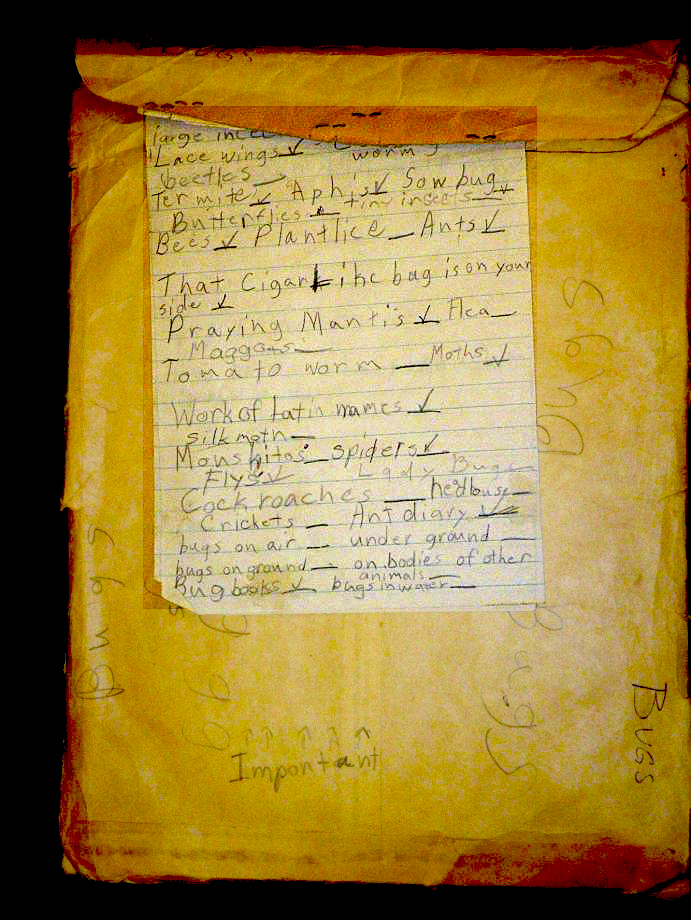
Early on (2nd grade for me), mom and dad encouraged us by subscribing to science kits that came in the mail monthly. We grew crystals, attached wires to things, had a little microscope with slides for looking at hairs, onion skin, amoebas. They supported my fascination with insects, spiders, and other multi-legged creatures. When mom kept finding “dead” sowbugs in the vegetable drawer of the refrigerator, she finally figured out that it was ME who was putting them there. Rather than having a tizzy, she asked “WHY?” I explained that the sowbugs weren’t dead at all, and if I warmed them up in my hands, they would come back to life. (I somehow knew better than to say that I questioned the miracle of resurrection that we had been taught in Sunday School, and was testing possible explanations.) In any case Mom said, “Well, if you’re doing experiments, you should record your results. She gave me some notebooks, manilla folders for keeping my results organized, an ant farm, a variety of containers for my sowbug experiments, and requested that I train the sowbugs to eat mint. (Mint was invading the garden.)
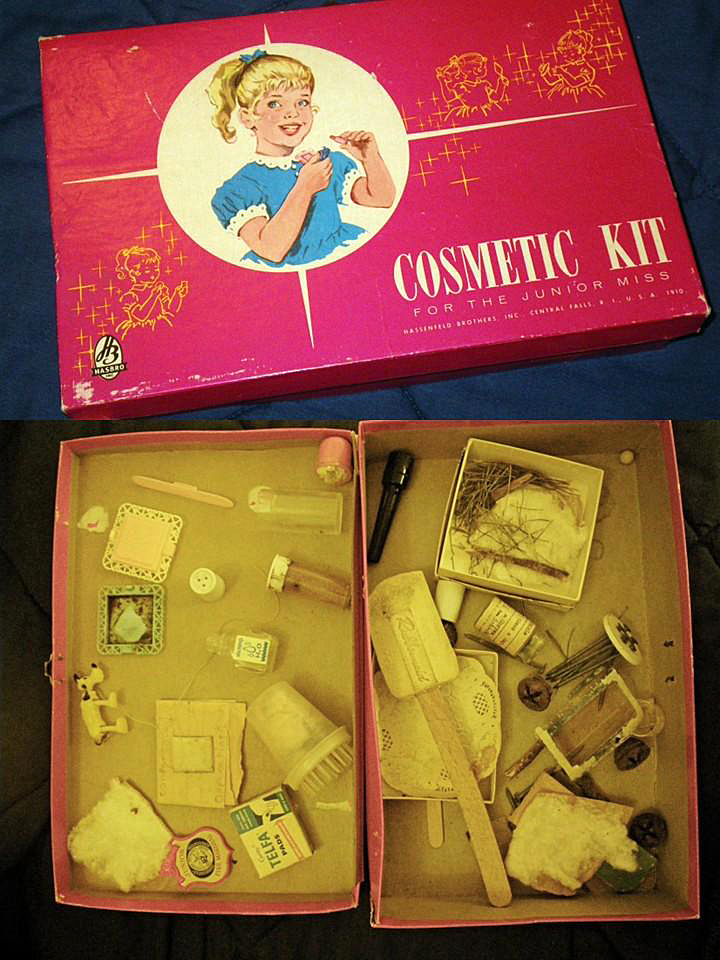
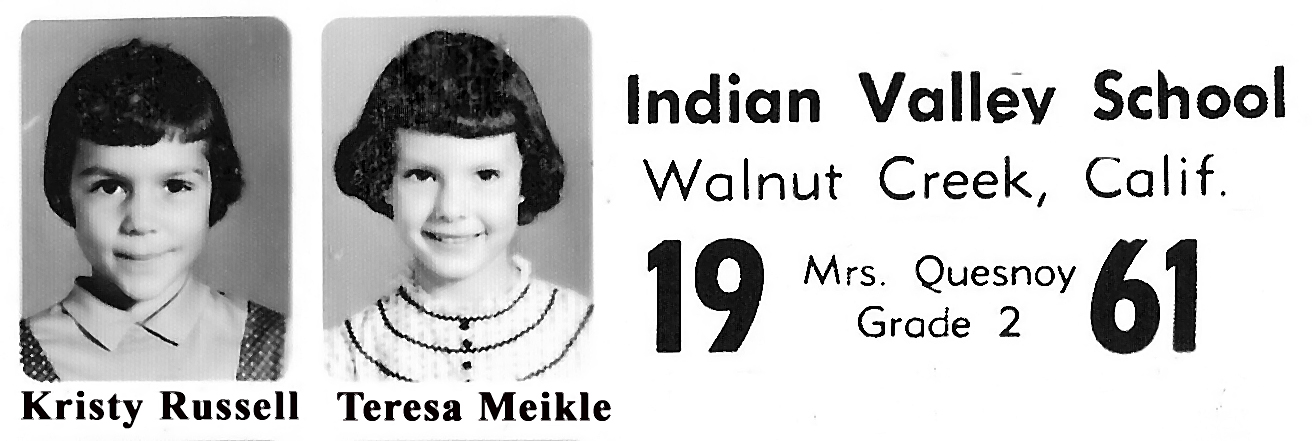 I started a bug club with my friend Kristy Russell, opened a bug hospital for the mint experiments, and Kristy and I had great times writing up our bug reports. I still have the reports and the bug hospital, which was housed in a 2nd grade birthday present of a “Cosmetic Kit”! I found the hospital, and a bundle of bug reports at Mom and Dad’s as we were cleaning out the house.
Best regards, and thanks! – Teresa
If you are wondering about the direction of Teresa's life, here is a brief resumé:
She got her B.S. and M.S. in entomology, worked in Forest Service and USDA labs, a museum in South Africa, and later got an MLIS (Masters in Library and Information Science), worked as a science reference librarian at the Library of Congress and California Academy of Sciences, as an information specialist at a biotech company, and lastly as a News Researcher for the Santa Rosa Press Democrat news media. She married Charles E. Griswold, noted arachnologist and Curator of Arachnology at the California Academy of Sciences.